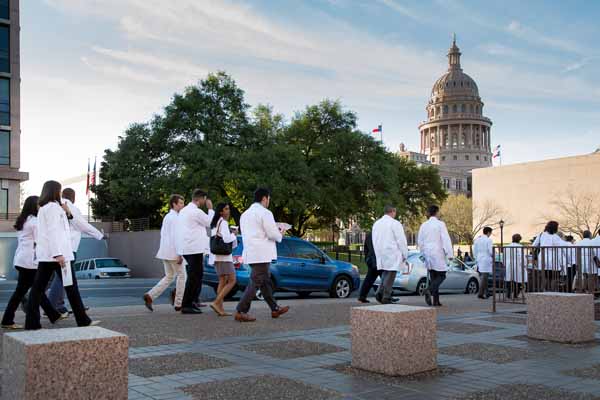
By addressing youth social media use, research, infrastructure, and more, the Texas Legislature invested in behavioral health legislation during the 2025 session.
Establishing a means to grow the state’s mental health workforce, Senate Bill 1401 requires the Texas Higher Education Coordinating Board to establish a Texas Mental Health Profession Pipeline Program, encouraging state institutions to develop guided pathways for aspiring mental health professionals. The bill went into effect Sept. 1.
Senate Bill 2069, establishing a work group to study the feasibility of an acute psychiatric bed registry, expressly calls for a Texas Medical Association representative to be included in the group. The bill addresses concerns about the strain intensive psychiatric care can place on emergency departments. A registry would allow physicians to know what facilities have available resources to take those patients.
TMA President Jayesh “Jay” Shah, MD, appointed Cheryl Lynn Hurd, MD, currently vice chair of TMA’s Council on Medical Education, to represent TMA. As of this writing, the work group has not yet been convened.
TMA also supported the two-step effort to fund dementia research. In May, legislators approved Senate Bill 5, proposing a constitutional amendment to fund a dementia research center, to receive up to $3 billion in funding over the next decade. Voters approved the funding measure in November.
Houston neurologist Reeta Achari, MD, testifying in support of the Dementia Prevention Research Institute of Texas’ (DPRIT’s) creation for TMA in March, previously told Texas Medicine Today that the institute could “attract much-needed physicians and subject matter experts and innovators from across the world” to make Texas a leader in dementia research.
The law authorizing the launch of DPRIT, modeled after the Cancer Prevention & Research Institute of Texas, is scheduled to go into effect Dec. 1.
But as of this writing, the state was navigating a lawsuit putting a pause on DPRIT, filed by a trio of plaintiffs contesting the 2025 election, claiming some voting machines were not certified by federal law.
Still, TMA expects the plans for DPRIT – which include the formation of an oversight committee, the selection of a chief executive officer and chief compliance officer, and consideration of grant applications from prospective researchers – will proceed.
Aligning with TMA to address children’s access to social media, Senate Bill 2420 places new guardrails on app stores, including requirements that app stores:
- Verify the age of the person attempting to purchase an app;
- Secure parental consent for a minor attempting to purchase an app;
- Verify the person providing parental consent is an adult;
- Display an age rating for apps; and
- Protect the personal data of users.
Support for SB 2420 is in line with TMA policy first approved in 2021, which “affirms that use of electronic social media platforms has the potential to negatively impact the physical, developmental, and mental health of individuals, and therefore these services should have established, evidence-based, reliable safeguards to protect youth from harm.”
The new law, effective on Jan. 1, 2026, faces a legal challenge from the Computer & Communications Industry Association, which contends the law violates First Amendment rights.
Meanwhile, TMA’s Committee on Child and Adolescent Health is preparing a report on phone-free schools to analyze the impact of technology on children’s health and well-being.
The Committee on Behavioral Health will continue to monitor the impact of legislation passed this year.
Check out TMA’s behavioral health resources housed on its website.
Phil West
Associate Editor
(512) 370-1394
phil.west[at]texmed[dot]org

Phil West is a writer and editor whose publications include the Los Angeles Times, Seattle Times, Austin American-Statesman, and San Antonio Express-News. He earned a BA in journalism from the University of Washington and an MFA from the University of Texas at Austin’s James A. Michener Center for Writers. He lives in Austin with his wife, children, and a trio of free-spirited dogs.