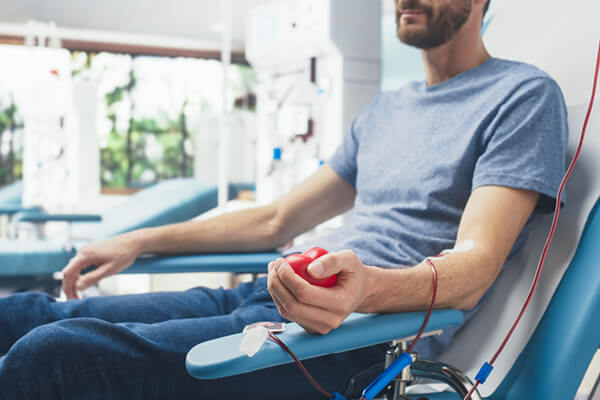
For the first time in its history, the Texas Medical Association’s annual meeting, TexMed, will host an on-site blood drive, reflecting burgeoning efforts in the state to bolster prehospital whole blood systems.
Coordinated by the Coastal Bend Blood Center, the blood drive will take place Friday, April 17, and Saturday, April 18, 2026, co-hosted by TMA’s Committee on Emergency Medical Services and Trauma (CEMST), the Subcommittee on Transfusion Medicine and Transplantation (STT), and the Nueces County Medical Society, and coordinated by the Coastal Bend Blood Center.
Participants will be able to direct donations to a prehospital whole blood program supporting emergency care through the Coastal Bend Blood Center’s EMS team and HALO-FLIGHT team, a nonprofit air ambulance program.
Whole blood is often more effective and more cost-efficient for treatment than using components of blood, according to Carlos H. Palacio, MD, a critical care surgeon in McAllen. Its potential to improve care captured the attention of the Committee on EMS and Trauma he participates in.
“Early studies from San Antonio showed there was a decrease in mortality when you give whole blood instead of component,” he said. “In another study, there was a decrease in cost. Nurses were more [adaptable] because instead of giving three bags to one patient, you only have to give one bag. Documentation is better: it’s just one form.”
Earlier this year, TMA physicians serving on CEMST and the Governor’s EMS and Trauma Advisory Council joined other stakeholders to request funding for the Pre-Hospital Whole Blood Task Force. The state responded with a $10 million allocation, more than double the initial ask, to build a statewide prehospital whole blood pilot program. Now, CEMST and STT continue to seek ways to support and augment the Whole Blood Task Force’s work as funds roll out – including the TexMed blood drive.
Blood drives are a way to increase the whole blood supply and build connections between donors, blood centers, and stakeholders, such as TMA and regional advisory councils (RACs).
“We have $10 million, that’s great, but there may not be $10 million worth of whole blood in the state,” said Nathan Ramon, executive director of Trauma Regional Advisory Council V (TRAC-V) in Harlingen. “Part of [RACs’] responsibility is to champion this program, to make sure that we’re helping the blood centers promote blood drives, and that we’re working with them to increase the donor pools.”
Traumatic injuries, gastrointestinal bleeding, and obstetric hemorrhaging are just a few cases that greatly benefit from whole blood use, Dr. Palacio says. In the South Texas region served by TRAC-V, whole blood saved a life within a week of being available, according to Mr. Ramon, when a patient injured by a saw received whole blood en route to a trauma center.
“The trauma surgeon who came out of surgery said whole blood probably stabilized the patient enough to save his life. If we didn’t have this, it may have been completely different. The immediate impact that it had was really noticeable.”
While participating in and facilitating blood drives is helpful, Dr. Palacio emphasizes successful implementation of whole blood distribution and use starts with demand from physicians.
“Our role as physicians is to make sure the administrators and the blood banks understand the importance of this,” he said. From there, EMS, clinic, and hospital administration can request participation in whole blood programs promulgated by RACs across the state.
At the TexMed blood drive, human leukocyte antigen (HLA) testing will be offered at no cost for individuals who wish to participate in the whole blood program, including previously pregnant donors. If interested in being tested, please notify Kathryn Clarke in advance in order to ensure the appropriate forms and additional sample tubes are available at the drive.
To ensure eligibility, regular donors are encouraged to schedule their last donation at least 56 days before the event.
For more information on whole blood programs, visit TRAC-V’s website.