
Three new state laws that specifically mandate CME, coupled with the Texas Medical Board’s (TMB’s) recent revamping of certain requirements, necessitate physicians reacquainting themselves with their CME obligations prior to renewing their licenses.
Additionally, another new law going into effect on Sept. 1 requires physicians to track CME electronically through a process overseen by TMB.
Together, the developments comprise arguably the most significant changes to CME requirements for Texas physicians since 2019, according to Texas Medical Association staff, when the Texas Legislature passed legislation requiring physicians to take opioid prescribing and human trafficking CME.
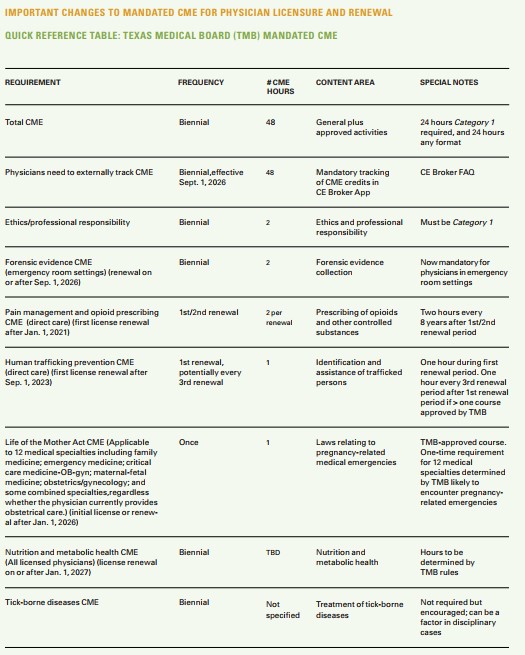
The basics remain the same: For each two-year cycle, a Texas physician must complete 48 CME hours, with 24 hours of AMA PRA Category 1 Credits™, plus 24 hours in any format. Those Category 1 credits must include two hours in ethics/professional responsibility.
While TMB still requires human trafficking prevention CME and pain management and opioid prescribing CME – which took effect Jan. 1, 2021, and Sept. 1, 2023, respectively – the agency’s guidance around re-upping that education shifted last year, reducing the overall number of those courses for physicians.
“It’s not always that people reduce requirements,” said Emmanuel Elueze, MD, PhD, chair of TMA’s Committee on Continuing Education, acknowledging that Texas legislators took a step to lessen the burden that physicians might find CME to be, based on TMA’s advocacy.
Yet, the new requirements around tracking CME, impacting all physicians seeking license renewal, may emerge as “one of the biggest consternations” for physicians weary of their existing administrative burdens, according to Cheryl Lynn Hurd, MD, vice chair of TMA’s Council on Medical Education.
The passage of Senate Bill 912 in the 2025 legislative session means starting Sept. 1, Texas physicians seeking license renewal from TMB will be required to log all CME via CE Broker, an online platform for CME management.
“Doctors have no choice,” Dr. Hurd said. “We’re going to have to be entering this data externally … you’re going to have to do it, or you can risk your license.”
Overall, the list of required CME courses for physicians has grown, though those requirements are dependent on a physician’s specialty and practice setting.
Per Senate Bill 31, also known as the Life of the Mother Act, physicians providing care for pregnant women in Texas must take a single one-hour course covering the new law’s updates on pregnancy-related medical emergencies. TMB has provided a list of 12 specialties, including family medicine and emergency medicine, required to take the course on its website. This requirement is specialty specific and is not dependent on whether the physician provides obstetrical care.
“Physicians were asking for clarification on the law,” Dr. Hurd said, noting that the CME will help them understand what care they can provide. “They wanted guidance because they were starting to get really afraid of providing any sort of care under the change in [state abortion] law.”
The sole eligible course as of this writing is offered for free via MyTMB and provides a downloadable certificate upon course completion.
“Any licensee who is required to complete the course will be unable to proceed with their renewal until the course shows as complete in our system,” TMB’s website states. At this time, physicians who are not in one of the defined medical specialties can access the CME course on TMB’s website but are not able to take it for CME credit.
Senate Bill 25 calls for a CME mandate for physicians on nutrition and metabolic health to begin Jan. 1, 2027. Development of the CME is contingent on state-appointed experts from the newly created Texas Nutrition Advisory Committee determining guidelines by Sept. 1, and TMB’s subsequent adoption of rules for course content. TMA staff says physicians should expect it to be a biennial requirement.
House Bill 47 requires emergency room physicians, starting Sept. 1, to take a two-hour mandatory CME course every two years. The compulsory curriculum includes forensic evidence collection guidelines for emergency departments treating sexual assault survivors.
But the CME requirements regarding human trafficking and opioids have been curtailed.
For opioid CME requirements, the former TMB rules required all physicians to take two hours every renewal period. The new rule now only cites the statutory requirement, which is limited to physicians that designate a direct patient care practice and contains the staggered temporal requirements.
For the trafficking CME requirements, the former TMB rules applied to all physicians, while the new rule cites the statutory provision, which is limited to those who designate a direct patient care practice.
Two hours of opioid CME is now required for physicians in their first and second medical license renewals, then every eight years thereafter – so, upon the sixth renewal, 10th renewal, and so on. TMA offers free CME meeting this requirement for its members.
Human trafficking CME is, as of this writing, limited to the physician’s first medical license renewal, with the sole one-hour TMB-approved course available. However, should TMB approve more than one course, physicians will have to take one hour of human trafficking CME every third license renewal period – once every six years following the first medical license renewal.
“From an educational perspective, in general, physicians are lifelong learners,” said Dr. Hurd, acknowledging that CME is part of physician licensing, even if the new tracking requirements have made it more burdensome.
Dr. Elueze offers some perspective for physicians weary of rules and lists.
“We should also remember that the goal of CME is to improve patient care,” he said. “Any rules or regulations concerning CME should be directed to help all of us improve patient care and the health care of those in Texas.”
Disclaimer. This information is provided as general information and is not intended to provide advice on any specific legal matter. This information should NOT be considered legal advice and receipt of it does not create an attorney-client relationship. This is not a substitute for the advice of an attorney. The TMA Office of the General Counsel provides this information with the express understanding that (1) no attorney-client relationship exists, (2) neither TMA nor its attorneys are engaged in providing legal advice, and (3) the information is of a general character. Although TMA has attempted to present materials that are accurate and useful, some material may be outdated, and TMA shall not be liable to anyone for any inaccuracy, error or omission, regardless of cause, or for any damages resulting therefrom. You should not rely on this information when dealing with personal legal matters; rather legal advice from retained legal counsel should be sought.
Phil West
Associate Editor
(512) 370-1394
phil.west[at]texmed[dot]org

Phil West is a writer and editor whose publications include the Los Angeles Times, Seattle Times, Austin American-Statesman, and San Antonio Express-News. He earned a BA in journalism from the University of Washington and an MFA from the University of Texas at Austin’s James A. Michener Center for Writers. He lives in Austin with his wife, children, and a trio of free-spirited dogs.